
# Kroger Scaled Back Its Robotics Bet. Its Next Move Shows What Actually Works in the Warehouse
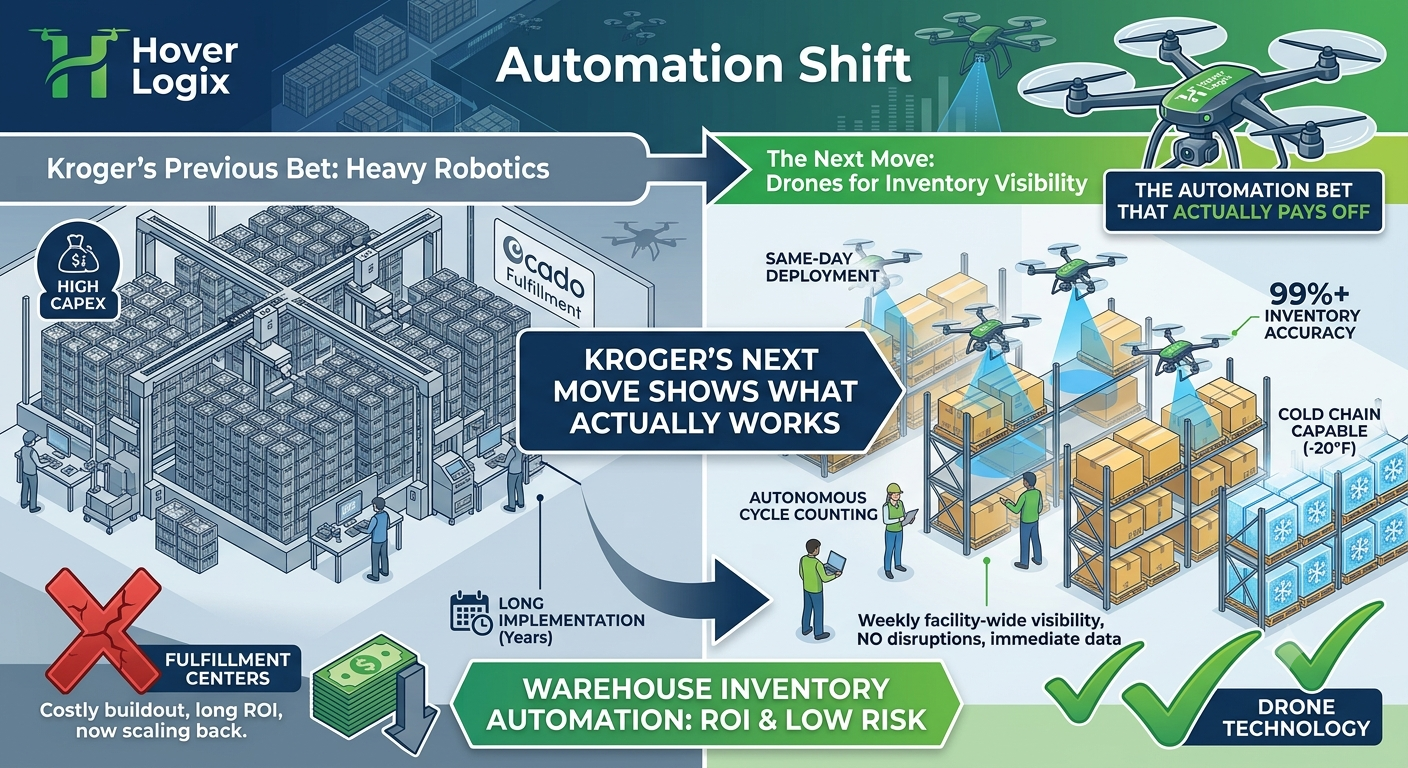
Kroger spent years and hundreds of millions of dollars building automated fulfillment centers with Ocado, then closed several of them when the returns didn’t hold up. That story made headlines across the grocery trade press. The story that didn’t get nearly as much attention: Kroger’s next automation move wasn’t another round of heavy robotics, it was drones.
In March, Kroger began using Corvus Robotics’ Corvus One for Cold Chain drones across its ambient and sub-freezing distribution operations, autonomously scanning pallet locations to deliver weekly, facility-wide inventory visibility instead of relying on manual physical counts. No construction. No new conveyor lines. No multi-year buildout.
That contrast is the story warehouse managers, 3PL operators, and supply chain directors should be paying attention to right now. The industry isn’t backing away from automation it’s getting pickier about which automation actually pays for itself.
The Robotics Retreat Nobody Expected
Automated fulfillment centers promised speed and precision at scale. For some retailers, they delivered. For Kroger, the math on its large-scale robotics buildout with Ocado stopped working, and the company began closing automated facilities a reversal significant enough that Grocery Dive covered it as a cautionary tale for the sector.
The lesson isn’t that robotics fail. It’s that fixed, high-CapEx automation carries real operational risk: long implementation timelines, facility-specific engineering, and a payback period that assumes years of stable volume. When demand shifts or the business case gets re-examined, that investment is hard to unwind.
Warehouse operators watching this play out are asking a sharper question than “should we automate?” They’re asking: which automation actually fits the risk profile of a mid-size distribution operation, and which requires betting the balance sheet on one architecture?
What Kroger Did Next Tells You Where the Market Is Headed
Weeks after the fulfillment center story broke, Kroger’s move with Corvus Robotics showed a different model entirely. The drones scan pallet locations across both ambient and sub-freezing zones down to -20°F without requiring WiFi, localization markers, lighting changes, special barcodes, or a human operator. According to Corvus Robotics, the deployment reduces the need for associates to perform manual counts in sub-freezing environments while improving shrink control, FIFO compliance, and data reliability for short shelf-life goods.
Kroger isn’t alone. Maersk, sportswear brand On, and UPS have all deployed Verity’s warehouse drones for similar inventory visibility use cases in recent years. The pattern across every one of these deployments is the same: drop-in inventory scanning that plugs into an existing facility rather than one that requires rebuilding it.
That’s the model Hover Logix was built around. Zero operational disruption, same-day photo-evidenced reports, and direct integration into the WMS or ERP a warehouse is already running no new infrastructure, no downtime for installation, no re-architecting the floor plan.
The Adoption Numbers Back This Up
This isn’t a fringe trend. Logistics trade association MHI projects that robotics and automation adoption among supply chain leaders will jump from 41% today to 83% within five years, and that inventory and network optimization technologies specifically will climb from 58% to 92% over the same period.
The businesses driving that curve aren’t all building new automated distribution centers. Many are layering targeted, lower-risk technology like drone-based cycle counting onto facilities that already work, closing the accuracy gap without the capital exposure of a full robotics overhaul.
That gap is bigger than most operators assume. Manual inventory counts typically run 63–80% accurate. Drone-based and autonomous scanning consistently hits 98–99%+, while covering a facility 3–5x faster than a manual cycle count crew. For a distribution center running on razor-thin fulfillment windows, that’s the difference between catching a stockout before it hits a customer order and finding out after.
Rack-Level Accuracy Without the Rack-Level Disruption
Every Hover Logix capability exists to close a specific operational gap warehouse managers already know they have.
Rack-level mapping and 3D warehouse models turn a flight over the facility into a navigable digital record useful for slotting decisions, space audits, and onboarding new staff without walking the floor. Same-day photo-evidenced reports mean a discrepancy isn’t just a number in a spreadsheet; it’s a timestamped image an operations manager can use to resolve a shrink dispute or a vendor claim the same day it’s flagged. Direct integration via CSV, REST API, or EDI X12 846/947 means inventory data lands in the WMS or ERP a team is already using no manual re-entry, no parallel system to maintain. And because the fleet is EASA-certified and operates out of the Netherlands, European operators get a compliance-ready partner rather than a pilot program stuck in regulatory limbo.
None of this requires a facility redesign. That’s the point.
The Real Decision Warehouse Managers Are Facing
The choice isn’t automation versus no automation anymore that debate is over. The choice is between automation that requires re-architecting the building and automation that plugs into the one you already have.
Kroger’s own trajectory over the past year makes the case better than any vendor pitch could: a costly retreat from heavy fixed robotics, followed almost immediately by adoption of exactly the kind of lightweight, drop-in inventory technology that doesn’t ask a facility to change shape around it.
For warehouse managers and 3PL operators evaluating where to put next quarter’s automation budget, that’s the signal worth acting on.
Ready to see what rack-level accuracy looks like in your own facility?
- Book a free consultation — walk through your current inventory accuracy gaps with our team at hoverlogix.nl
- Request a ROI analysis — get a data-backed estimate of what drone-based cycle counting saves your operation, at hoverlogix.nl
- Schedule a live demo — see a rack-level scan and 3D warehouse model built from your own facility layout, at hoverlogix.nl
Hover Logix is a drone-powered warehouse inventory management company based in the Netherlands. We help warehouse operators, 3PL providers, and distribution centers replace manual cycle counts with drone scanning delivering 98-99%+ inventory accuracy, same-day photo-evidenced reporting, and direct WMS/ERP integration, all without disrupting daily operations.